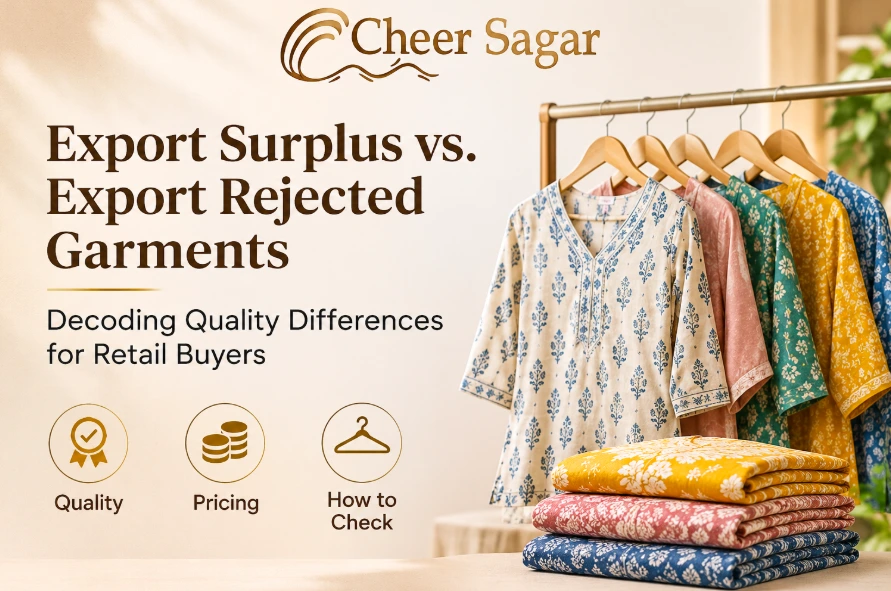
In the apparel manufacturing industry, surplus production is a standard practice. Surplus stock may be required for several reasons, and having no additional stock available can sometimes result in losing a client’s trust when they place future orders. Therefore, surplus production does not necessarily mean substandard production. These garments are manufactured according to the same export quality standards as the products shipped to the original buyer.
On the contrary, export-rejected garments are pieces that have manufacturing defects. These garments have failed quality assurance (QA) or quality control (QC) inspections, either during the manufacturer’s internal checks or during the buyer’s final inspection. Export surplus is first-quality stock, whereas rejected garments are not and should be priced accordingly.
Although these two terms are often used together, retailers need to understand their differences before purchasing stock. Here’s a detailed guide to differentiating between export surplus and export-rejected garments.
What Is Export Surplus Clothing?
Export surplus clothing refers to garments manufactured according to the specifications of an international order that have successfully passed quality control but remain unsold or unused. These garments use the same fabric, stitching, and finishing standards as the products delivered to the original buyer. The only difference is that they never reached the intended customer.
There are four main reasons why export surplus garments are available:
- The buyer cancels or reduces an order during production.
- The factory produces additional garments to account for possible manufacturing losses.
- The season ends, and the buyer is no longer willing to accept a delayed delivery.
- Manufacturers produce extra stock to accommodate possible last-minute orders.
Cheer Sagar, a Jaipur-based apparel manufacturer and exporter, offers this type of stock as export surplus garments in India. These garments are manufactured following the same production standards as its regular export orders.
What Are Export-Rejected Garments?
Export-rejected garments are pieces that fail the buyer’s final inspection or the manufacturer’s internal quality assurance and quality control checks during or after production.
Common reasons for rejection include uneven stitching, colour variations between fabric panels, incorrect measurements, stains, and printing defects. Although a rejected garment may not always be unusable, it carries a higher quality risk and should be priced accordingly.
Some defects are minor, such as loose threads, and these garments may be rechecked and sold as B-grade products. Other problems, such as incorrect measurements across an entire size range, may be difficult or impossible to correct.
The problem arises when B-grade or mixed-quality garments are sold as export surplus. This is why retailers should pay attention to the quality grade mentioned on the invoice, rather than considering the price alone.
How Do Export Surplus and Export Rejects Compare?
Export surplus and export rejects are two different categories of garments. They differ in several aspects that matter to retailers, including quality standards, defects, labels, pricing, and return risks.
Export surplus is generally suitable for regular online and offline retailers, boutiques, and fashion businesses. Rejected garments are more appropriate for discount stores and resale channels where customers understand that they are purchasing lower-grade products.
| Factor | Export Surplus | Export Rejects |
|---|---|---|
| Quality standard | Passed buyer QC | Failed QC; some may be re-graded as B-grade |
| Defects | No defects beyond normal tolerance | Stitching, shade, measurement, stain, or print faults |
| Labels | Brand labels may be intact, cut, or removed as per buyer requirements | Labels are often cut, marked, or removed |
| Pricing | Usually cheaper than fresh production | Lowest pricing, depending on grade and defects |
| Return risk | Low | Medium to high |
| Best for | Boutiques, online stores, and regular retailers | Discount stores, street markets, and bulk resellers |
How Can Retail Buyers Check Quality Before Buying?
Retail buyers should always verify the quality of garments before making a bulk purchase. A quality control report, samples from the actual lot, and clear information about label status can provide a better understanding of the products than sales promises.
Here are some important checks to perform before purchasing export surplus or rejected garments:
1. Check the QC Report and AQL Level
Ask the supplier which quality inspection the garments have passed and at what Acceptable Quality Limit (AQL). A quality inspection report provides useful information about the condition of the stock. The absence of a report should be treated as a warning sign.
2. Request Samples Before Placing a Bulk Order
Always request samples from the actual stock lot you intend to purchase. Even when buying B-grade garments, avoid relying solely on showroom samples, as they may not represent the quality of the entire lot.
3. Inspect Seams and Measurements
Examine the stitching, seams, and important garment measurements. Compare the measurements with the supplier’s size chart to ensure that the products meet your retail requirements.
4. Check Shade Consistency
Compare garments from different cartons under natural daylight. This helps identify colour variations between pieces that may not be noticeable under artificial lighting.
5. Verify Label Status
Confirm whether the original brand labels are intact, cut, or completely removed. Understanding the label status is important when purchasing factory surplus stock.
Here’s a guide on how to spot authentic factory surplus.
6. Check Size-Run Completeness
Ensure that the stock includes a commercially useful range of sizes. Some surplus lots may contain mostly leftover larger or smaller sizes, making them difficult to sell through regular retail channels.
For a more detailed checklist, see these 12 questions to ask a garment manufacturer before placing a bulk order.
Looking for First-Quality Surplus Stock?
As one of the garment manufacturers in India, Cheer Sagar offers retailers and businesses an opportunity to explore export surplus garments manufactured according to international order requirements.
You can contact Cheer Sagar to enquire about currently available export surplus lots and request samples before committing to a bulk purchase.
Request a quote or download the company profile to learn more about its manufacturing and export services.
FAQs
1. Is Export Surplus the Same as Export Rejects?
No. Export surplus garments have passed the buyer’s quality checks but were left over from the original order. Export rejects, on the other hand, have failed quality inspections. Surplus is considered first-quality stock, whereas rejected garments may contain defects and are generally sold as B-grade products at lower prices.
2. Is Export Surplus Cheaper Than Fresh Manufacturing?
Usually, yes. Export surplus garments are generally available at lower prices because most of the original production costs have already been covered by the initial order. However, buyers have limited choices regarding styles, colours, and available sizes. For customised designs and specific requirements, a readymade garments manufacturer can produce fresh stock.
3. Can I Return Defective Pieces From Surplus Lots?
Return policies depend on the supplier’s terms and conditions. Many surplus lots are sold on an as-is basis. Before purchasing, request samples, review the QC report, and confirm the acceptable defect allowance and return conditions in writing.
4. What MOQ Applies to Surplus Stock?
The minimum order quantity (MOQ) for surplus stock depends on the available lot size and packaging requirements. It may differ from the MOQ applicable to fresh production orders. Buyers should contact the supplier to understand the minimum quantity requirements before placing an order.