
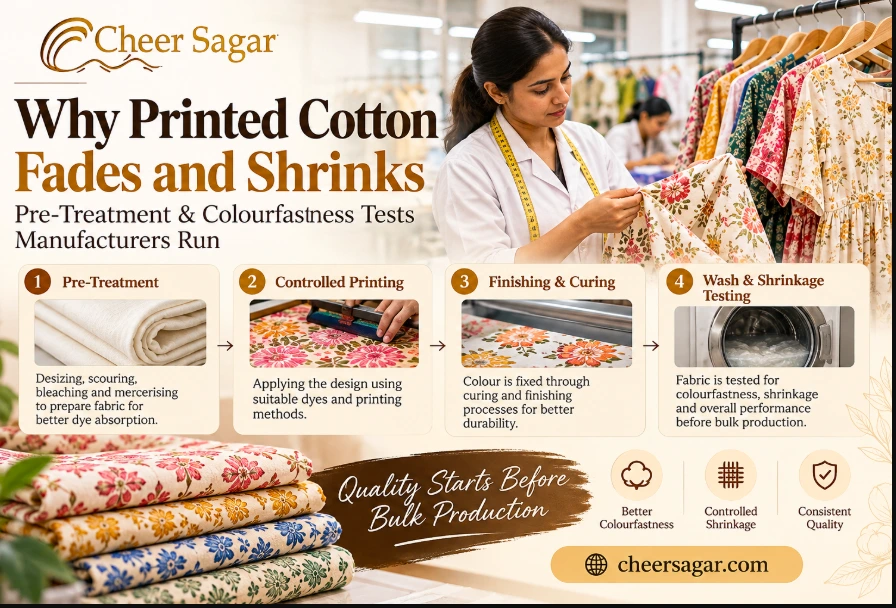
Colourfastness is a common concern with natural fabrics like cotton. In most cases, printed cotton fabric can fade when dyes or pigments are not properly fixed, while cotton shrinks when yarns relax after washing. To address these problems, manufacturers prepare the fabric before dyeing to improve dye absorption and reduce the risk of colour fading.
There are four main processes used: pre-treatment, controlled printing, finishing, and wash testing before bulk production. Buyers may request a detailed colourfastness report for the fabric or garment before bulk production to ensure it aligns with client requirements.
Why Does Printed Cotton Fade?
Printed cotton fades when colour does not bond properly with the fabric. General deterioration of printed colours over time is normal, but if it happens too quickly, it could be caused by:
- Unfixed dye or pigment: Colour that has not been adequately fixed can wash out.
- Poor wash-off: Residual dye left after processing may cause colour bleeding during laundering.
- Unsuitable dyes or binders: Incompatible materials can reduce colour retention.
- Sunlight exposure: Constant exposure to sunlight can gradually fade colours.
- Harsh washing: Using hot water, strong detergents, bleach, and aggressive washing can accelerate fading.
The printing method alone does not determine colourfastness. Other factors are involved, as mentioned above. As a buyer, you should ask how the fabric was processed and whether the finished print has undergone appropriate testing before purchasing.
Why Does Cotton Shrink After Washing?
Cotton shrinks because yarns and fibres relax after washing. Cotton fibres and yarns are placed under tension during spinning, weaving, or knitting. Moisture and washing can subsequently contribute to dimensional changes in cotton garments.
Shrinkage matters in bulk garment production because it can affect fit, garment length, and size consistency. Even when the original measurements are correct, excessive shrinkage may result in customer complaints. Before production, agree on an acceptable shrinkage tolerance with your manufacturer in writing.
After receiving the approved sample, wash it to check whether the measurements remain consistent after laundering. This test is especially important for children’s clothing, as fabric comfort and care requirements should be considered when comparing cotton vs polyester frocks for kids.
What Pre-Treatment Steps Do Manufacturers Perform Before Printing?
Pre-treatment prepares fabric for printing, helping colours apply consistently and perform as intended. So, what is pre-treatment, and what steps do manufacturers perform before printing? Let’s find out.
- Desizing: Removes sizing agents applied during weaving.
- Scouring: Removes oils, waxes, and other impurities that can interfere with colour absorption.
- Bleaching: Lightens the fabric when a cleaner or more uniform base is required.
- Mercerising: Treats cotton to improve properties such as dye affinity and fabric lustre.
- Pre-shrinking: Reduces subsequent size changes through controlled treatment.
- Printing: Applies the selected design using the chosen printing method.
- Curing: Helps secure the colour, depending on the dye or ink system.
- Wash-off: Removes residual colourants or processing chemicals.
Which Colourfastness and Shrinkage Tests Should You Ask For?
Ask your manufacturer which tests are performed, whether testing is conducted in-house or by an external laboratory, and whether reports are available for your order.
| Test | Standard reference | What it checks |
|---|---|---|
| Colourfastness to washing | ISO 105-C06 | Colour loss during laundering |
| Colourfastness to rubbing | ISO 105-X12 | Colour transfer during dry or wet rubbing |
| Colourfastness to light | ISO 105-B02 | Colour fading under artificial daylight |
| Colourfastness to perspiration | ISO 105-E04 | Colour changes caused by exposure to sweat |
| Dimensional change after washing | ISO 6330 / ISO 5077 | Shrinkage or stretching after washing |
Colourfastness results commonly use a grey scale rated from 1 to 5. A higher score generally indicates better colourfastness performance, meaning greater resistance to colour change or transfer. The applicable test method and acceptance criteria should be agreed upon before manufacturing.
What Should You Ask Your Manufacturer Before Bulk Production?
Printed cotton garments are not inherently prone to excessive fading and shrinking. The pre-production processing of the fabric and curing of the print help determine how well the garment retains its colour and dimensions after regular use.
As a buyer, make sure you ask for relevant colourfastness reports and shrinkage test results. For more information about pre-production processes that help prevent cotton fading and shrinking, contact Cheer Sagar to discuss your fabric requirements before finalising an order. Visit Cheer Sagar to learn more about its garment manufacturing services.
Frequently Asked Questions
1. How much shrinkage is normal for cotton garments?
Acceptable shrinkage depends on the fabric, construction, and finishing. Agree on a written tolerance with your manufacturer and verify it through a wash test on the approved sample.
2. Can printed cotton be made completely fade-proof?
No fabric can be guaranteed to remain completely fade-proof under every condition. Suitable colourants, correct fixation, proper wash-off, and appropriate care can help minimise fading.
3. What is a colourfastness test?
A colourfastness test evaluates how well fabric colour resists washing, rubbing, light, or perspiration. Results help buyers assess performance against agreed requirements before bulk production.
4. Does pre-washing fabric before stitching help?
Yes. Appropriate pre-shrinking or fabric relaxation can reduce dimensional changes after washing. The process should suit the fabric, and results should be checked against the