
What Is A BOM (Bill Of Materials) In Garment Manufacturing?
What Is a BOM (Bill of Materials) in Garment Manufacturing?
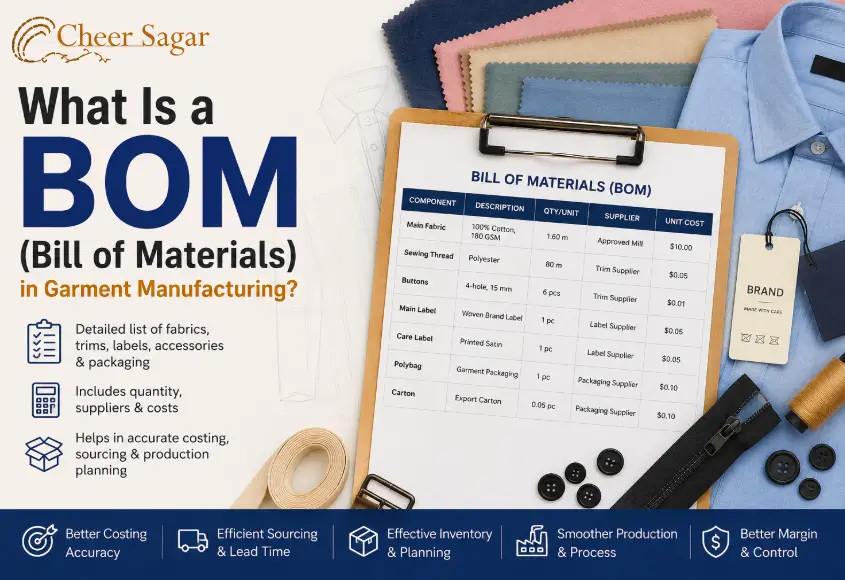
Quick Answer: A BOM (Bill of Materials) as the name suggests is a detailed list of fabrics, trims, accessories, labels, and packaging components required to produce a garment. The list also contains the information about the quantities each element is required in, the supplier for each element, and their respective costs. You can think of it like an invoice with the complete list of all the “raw materials” required to develop a finished garment. The BOM serves as a master reference for a garment export house to calculate costs, plan sourcing, manage inventory, and prepare accurately for bulk production.
What is a BOM in Garment Manufacturing?
The BOM is an important document in apparel manufacturing. It creates an accurate list of materials required to bring any design to life when it has been confirmed. The most important part of the BOM is the costing of each material and how it helps tabulate the total production cost of a garment. This is the metric that a garment export house shares with the buyer once the BOM is generated.
With this information, it allows buyers to determine their price point for the garments and also understand the total investment required for bulk production or even a limited production run of said garment. Manufacturers on the other hand, keep a close track of how each component contributes to the final garment cost.
What’s Included in a Garment BOM?
A garment BOM generally includes every material and component that goes into making, finishing, and packing the product.
Key elements include:
-
Main fabric: Fabric type, composition, color, GSM, width, and consumption per garment.
-
Trims: Zippers, buttons, elastic, cords, hooks, and other functional components.
-
Labels: Main labels, size labels, care labels, and country-of-origin labels.
-
Accessories: Embroidery threads, patches, tapes, interlinings, and other design-specific components.
-
Packaging: Polybags, cartons, hangtags, stickers, tissue paper, and other packing materials.
-
Consumption: The estimated quantity of each component required per garment.
-
Supplier and cost: Approved supplier information and the unit cost of each component.
The BOM should be updated whenever an approved material, quantity, or specification changes during product development.
BOM vs Tech Pack: What’s The Difference?
|
Document |
Primary Purpose |
Typically Includes |
|
BOM |
Defines materials and costs |
Fabrics, trims, labels, accessories, consumption, suppliers, costs |
|
Tech Pack |
Defines how the garment should be made |
Measurements, construction, sketches, specifications, grading, BOM |
So, in short, BOM is a part of a tech pack, but the tech pack includes more components than just the BOM. The tech pack explains how the garment is going to be made. The BOM is just a list of what materials are required to make the garment.
Why Private Label Manufacturers Depend on Accurate BOMs
For a private label manufacturer, BOM accuracy directly affects production efficiency and profitability. Even a small omission can become significant when multiplied across thousands of garments.
An accurate BOM helps with:
-
Costing Accuracy: Every fabric, trim, label, and packaging component is accounted for before the manufacturer quotes the order.
-
Sourcing Lead Times: Purchasing teams can identify materials that require longer procurement or development periods.
-
Inventory Planning: Exact consumption figures help calculate the quantities required for bulk production.
-
Production Continuity: Having materials ready before cutting and sewing reduces the risk of production stoppages.
-
Margin Protection: Complete costing prevents manufacturers from underestimating the actual production cost.
Sample Garment BOM
|
Component |
Description |
Consumption/Unit |
Supplier |
Unit Cost |
|
Main fabric |
100% cotton, 180 GSM |
1.60 metres |
Approved mill |
$10 |
|
Sewing thread |
Polyester |
80 metres |
Trim supplier |
$5 |
|
Buttons |
4-hole, 15 mm |
6 pieces |
Trim supplier |
$1 |
|
Main label |
Woven brand label |
1 piece |
Label supplier |
$0.05 |
|
Care label |
Printed satin |
1 piece |
Label supplier |
$0.05 |
|
Polybag |
Garment packaging |
1 piece |
Packaging supplier |
$0.1 |
|
Carton |
Export carton |
0.05 piece |
Packaging supplier |
$0.1 |
This is just a sample garment BOM; an actual BOM can only be made once the garment design is finalised and all the materials are confirmed.
Common BOM Mistakes That Delay Production
Certain BOM errors are common and can cause significant problems once bulk production begins.
-
Missing trims, labels, or packaging components
-
Incorrect fabric consumption calculations
-
Outdated supplier or pricing information
-
Failing to account for production wastage
-
Using different specifications between the BOM and the approved sample
-
Not updating the BOM after sample revisions
-
Starting bulk production before the BOM is finalized
Conclusion
A BOM is an important part of a professional tech pack. It helps keep production in-line with buyer expectations while clearly laying out the cost-per-garment. The BOM also allows complete transparency between buyer and manufacturer to ensure that the buyer always has detailed information regarding the supplier for each component of their garments. You can learn more about BOMs and tech packs in general from Cheer Sagar. As a major garment export house in India, Cheer Sagar handles bulk garment manufacturing orders from six continents globally. Check out their website to learn more about their services.
FAQs
-
Is a BOM the same as a tech pack?
No. A tech pack contains measurements, construction details, and garment specifications, while a BOM focuses specifically on materials, components, consumption, suppliers, and costs. The BOM may be included within the tech pack.
-
Who creates the BOM, the buyer or the manufacturer?
The manufacturer or private label partner typically prepares the BOM. It is developed using the buyer's tech pack, approved sample, material specifications, and production requirements.
-
Why does BOM accuracy affect pricing?
Every material and component contributes to the garment's total production cost. An incomplete BOM can cause under-quoting, unexpected sourcing expenses, and reduced production margins.
-
Does the BOM change after sampling?
Yes. The BOM is commonly revised after each sampling round as fabrics, trims, consumption, or specifications are finalized. Once the PP sample is approved, the BOM should be locked for bulk production.
-
Can a BOM help avoid production delays?
Yes. An accurate BOM identifies the exact materials and quantities required in advance, allowing sourcing teams to order components early and reducing the risk of shortages during production.

Related Blog
Building A UK-Ready Apparel Supply Chain From India
As the global fashion industry continues to evolve, UK retailers are increasingly looking towards India for high-quality, affordable, and trend-driven...
Learn The Steps On How To Start Your Dream Fashion Boutique Business
Starting your fashion boutique is a dream for many, and for many years, it has remained a dream only....
How To Manufacture Women’s Shorts For Your Clothing Brand
Launching a clothing brand comes with countless decisions, but when it comes to creating women's shorts, getting the manufacturing process...