
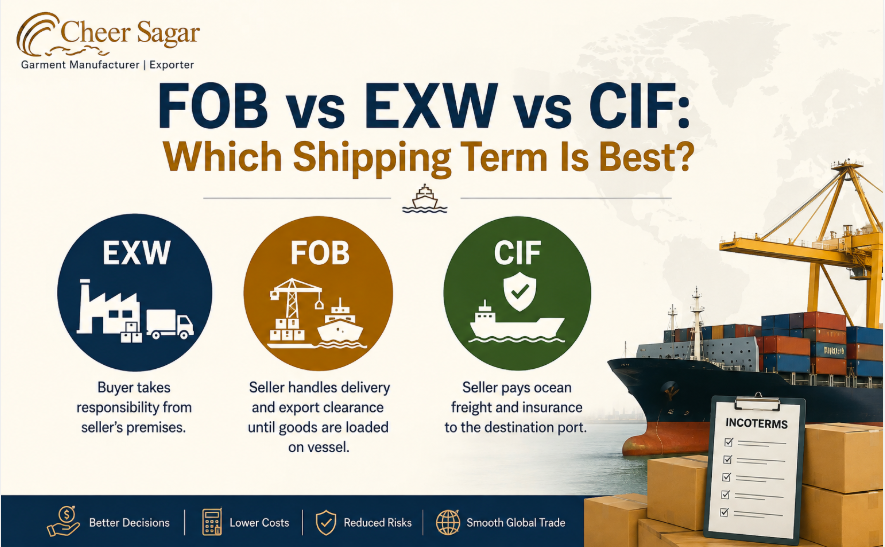
Ex Works (EXW) means the buyer takes responsibility from the seller’s premises. Free on Board (FOB) means the exporter handles delivery and export clearance until the goods are loaded on the vessel at the agreed port, and lastly, Cost Insurance Freight (CIF) means the exporter also pays ocean freight and insurance to the destination port. These are the three most commonly used shipping terms for garment exports by apparel exporters India.
Beyond their expanded forms, each of these shipping terms carry significant rules and responsibilities for both the buyer and the Indian garment exporters. It is important to note that each of these shipping terms are the equivalent of a contract and agreement between two parties. So, to help you understand it better, here’s a clear differentiation and overview of all three shipping terms.
- EXW: This arrangement requires the seller to make the finished good available at its premises. The buyer then arranges for pickup, inland transportation, export clearance, main carriage, insurance, and delivery. This is a strategy that clearly favours the manufacturer as it requires the least responsibilities from their end. It is best suited for buyers with an extensive logistics network who also want maximum control over transportation.
- FOB: This arrangement has the seller handle delivery to the named port, export customs clearance, and loading the goods on board the vessel. Once the shipment is on the way, receiving it and arranging for picking, inland transportation, and final delivery become the responsibility of the buyer. Buyers who want control over international freight while having the exporter handle the origin-side export process.
- CIF: Under this arrangement, the seller arranges and pays for ocean freight and insurance to the named destination port. However, the risk transfers to the buyer once the goods are loaded on board at the origin port. This strategy is best suited for buyers who prefer the exporter to arrange main ocean freight and insurance.
| Responsibility | EXW | FOB | CIF |
|---|---|---|---|
| Factory pickup | Buyer | Seller | Seller |
| Export clearance | Buyer | Seller | Seller |
| Inland transport to origin port | Buyer | Seller | Seller |
| Loading on vessel | Buyer | Seller | Seller |
| Main ocean freight | Buyer | Seller | Seller |
| Marine insurance | Buyer | Seller | Seller |
| Destination port charges | Buyer | Buyer | Buyer |
| Risk transfer | Seller’s premises | On board vessel | On board vessel |
FOB is the middle ground among the different export options we’ve discussed. This is primarily because it divides the responsibility of export in some way equally between the buyer and the seller. It also allows buyers to maintain a relatively affordable cost per garment and allows sellers to ensure local logistical support for buyers, which would be a difficult process for foreign buyers otherwise.
For apparel exporters India, this arrangement also makes quotations easier to compare across suppliers. Buyers can negotiate their ocean freight separately based on their preferred forwarder, carrier, destination, and shipment volume.
For a leading garment manufacturer India, FOB can therefore provide a straightforward commercial structure without requiring the manufacturer to manage the buyer’s entire international logistics chain.
FOB isn’t automatically the best option for every order. The choice is always what you can negotiate with the buyer. So, when should you choose CIF or EXW? Here’s a way to get started thinking about them.
Choose EXW when:
- You have a trusted freight forwarder in India.
- You want complete control over transportation.
- Your logistics partner can efficiently manage export formalities.
- You regularly consolidate shipments from multiple suppliers.
Choose CIF when:
- You are a first-time importer with limited logistics experience.
- You want the exporter to arrange ocean freight.
- You are comfortable receiving a single price through the destination port.
- The exporter has competitive freight rates.
For smaller LCL (Less than Container Load) shipments, freight and handling charges can behave differently from FCL shipments, so buyers should compare the complete landed cost rather than choosing an Incoterm based only on the quoted garment price.
The price quoted by an Indian garment exporter isn’t necessarily the final cost of getting garments into your warehouse. Based on the shipping strategy you adopt, there will be extra expenses unless you’ve opted for CIF. As a buyer, you must understand that these costs cut into your profit margins and can require you to alter the selling price of your garments. If you’re intending to sell in a cost-sensitive market, this move can potentially push your products out of contention for market approval.
So, how should you calculate your final garment cost or landed cost? Here are the calculations you must consider:
Product cost + origin charges + freight + insurance + customs + duties/taxes + destination charges + inland delivery = landed cost.
Even though FOB is the practical middle ground where the exporter manages the origin-side process, and the buyer retains control over international freight, it is not the standard default you must agree to. Each of these strategies have their own benefits and risks, and you must weigh your options accordingly and choose the one that suits your business the best. For more information regarding apparel exporters India, check out Cheer Sagar. They are among the leading garment manufacturer India and have decades of experience shipping garments to six continents globally. Check out their website to learn more about their services.
-
Which Incoterm is most common for Indian apparel exports?
FOB is one of the most widely used terms for apparel exports from India. It provides a practical balance between exporter-managed origin logistics and buyer control over international freight.
-
Is EXW cheaper than FOB?
The EXW unit price is usually lower, but that does not necessarily make it cheaper overall. The buyer must account for pickup, export clearance, inland freight, and other origin charges when calculating total landed cost.
-
What does CIF include that FOB doesn’t?
CIF includes the seller-arranged ocean freight and marine insurance to the named destination port. Under FOB, the buyer normally arranges and pays for the main international freight and insurance.
-
Which term gives the buyer the most control over shipping?
EXW generally gives the buyer the greatest control over the logistics chain. The buyer arranges transportation from the seller’s premises onward, although handling export formalities under EXW can be less convenient for overseas buyers.
-
Can I negotiate Incoterms per order?
Yes. Incoterms can be agreed for individual purchase orders and may vary according to shipment size, destination, logistics arrangements, and the capabilities of both parties.