
Vietnam Vs India Garment Manufacturing
Introduction
If you're building a fashion brand or scaling one, choosing where to manufacture is one of those decisions that quietly impacts everything: your margins, product consistency, delivery timelines, and even how smoothly your next collection launches. If you are scouting for the right garment manufacturing partner, you have very likely landed between two powerhouses: Vietnam and India. Both nations are global leaders in apparel production, but they serve very different needs, and the difference between them isn't just geographical; it comes down to cost structure, MOQs, fabric sourcing options, product strengths, lead times, customisation flexibility, compliance, and trade access. This guide breaks all of that down in one place, so you can make an informed sourcing decision based on what your brand actually needs, not just industry hype.
The State of Garment Manufacturing: Vietnam vs India Today
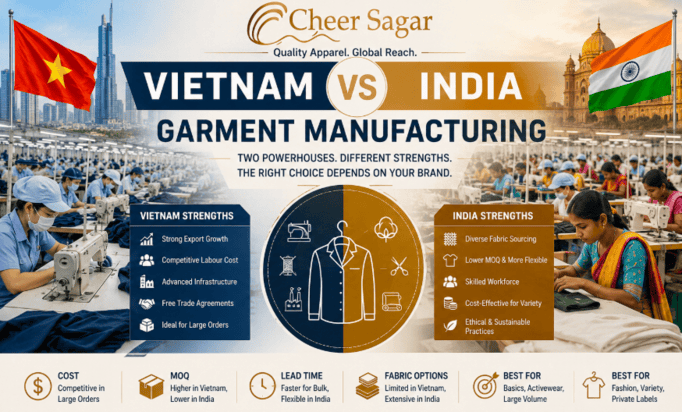
Vietnam has earned its place as the world's third-largest textile and garment exporter, generating an impressive USD 44 billion in export revenue in 2024 — an 11% year-on-year increase. The country benefits from key free trade agreements including the CPTPP, EVFTA, and RCEP, making it an attractive option for brands targeting US and EU markets. Major global brands — Nike, Adidas, and H&M rely heavily on Vietnamese factories, and the country's labour costs remain competitive, with proximity to Chinese raw-material supply chains helping fast turnaround.
India, meanwhile, is one of the world's most diverse and self-sufficient textile ecosystems. As the sixth-largest producer of textiles globally, India covers over 80% of its raw material needs domestically — from cotton and silk to man-made fibres — giving it a distinct edge in cost control and supply chain flexibility. The new India–EFTA TEPA agreement (enforced October 2025) has also eliminated tariffs on Indian garments entering Switzerland, Norway, Iceland, and Liechtenstein, opening fresh export corridors for Indian apparel manufacturers.
Cost Comparison
Many buyers start with one question: “Which country is cheaper?” The honest answer is that it depends on what you're making and how you're measuring cost.
Vietnam is often competitive for large-scale production, especially when styles are consistent and orders are high-quantity. The cost per piece can look attractive when factories run long production lines with minimal changeovers — though, much like China, Vietnam's production costs have increased significantly in recent years.
India can be extremely cost-effective too, and although India is not typically known for low-cost labour, its manufacturing cost still resembles China's for international brands thanks to the dollar/pound-to-INR exchange rate. India's bigger cost advantage, though, is value-for-money once fabric options, embellishment, printing, and smaller-batch variety are
factored in. If a brand needs multiple colourways, frequent design tweaks, or mixed styles in one order, India often delivers better overall value even if the per-piece quote looks similar. India's labour laws are also structured to prevent the exploitation of workers, which supports consistently ethical and sustainable manufacturing.
MOQ (Minimum Order Quantity) Comparison
MOQ is where many brands feel the difference between the two countries immediately.
Vietnamese factories can be excellent, but many are structured for bigger runs; large brands tend to dominate factory capacity, which can leave smaller brands with deprioritised orders and pressure to order more than they're ready to sell. Roughly 70% of Vietnamese manufacturers operate under the Cut-Make-Trim (CMT) model, which limits value-added and small-batch flexibility.
India is generally far more flexible, especially with manufacturers who support smaller brands and growing labels. There is more willingness to experiment with limited runs, add variations, or produce across multiple sizes and colours without the process feeling impossible. That said, MOQ standardisation is itself less uniform in India; requirements can vary from region to region and supplier to supplier, so it's worth confirming a manufacturer's specific MOQ against your own requirements. This flexibility is especially valuable for private label children's clothing lines or kidswear brands, which typically need many sizes and frequent replenishment.
Product Strengths & Design Capability
A simple way to decide is to match the country to your product category.
Vietnam tends to be strong in clean construction basics, uniform quality at large quantities, some categories of knitwear and performance-style production, and streamlined bulk manufacturing for repeat styles. Its industry is modelled closely on China's, focused on efficiency and machinised consistency, a good fit for fast-fashion requirements, though it leaves comparatively little room for design customisation.
India tends to be strong in cotton-based garments, prints, and craftsmanship; embellishments, embroidery, and design variety; smaller-batch flexibility and mixed orders; and a wide category range from casual to ethnic-inspired fusion wear. India's manufacturing heritage runs deep: numerous indigenous styles, from tie-dye to batik print, that are popular internationally today originated in India, giving brands that manufacture there ac
cess to authentic designs at their source. Unlike Vietnam's CMT-dominant structure, Indian manufacturers commonly offer full OEM and ODM services, meaning a brand gets design support, fabric sourcing, sampling, and production under one roof. If you're building a women's line and want variety in fabrics, prints, silhouettes, and finishing, India can be a strong match, especially with a manufacturer that offers sampling support and in-house fabric sourcing.
Fabric Sourcing & Supply Chain Self-Sufficiency
Vietnam has a strong supply chain, but many buyers still import certain fabrics or trims depending on the product. Domestic fabric production covers only around 25–30% of national demand, which can affect both timeline and cost when sourcing is split between countries.
India has one of the widest fabric ecosystems available: cotton, blends, voiles, cambric, denim, knits, and extensive print/processing options covering over 80% of its raw-material needs domestically. If a brand's designs depend on fabric variety, or the brand wants a unique signature look, India's depth here is a significant advantage.
Lead Time: Planning Beats Guessing
Lead time isn't only about how fast a factory can stitch garments; it's the full chain: sampling and revisions, fabric and trim procurement, production scheduling, quality checks, and packing and shipping.
Vietnam can be fast and consistent for repeat bulk orders where everything is locked in. India can be just as quick, especially when fabric and processes are local and the manufacturer is responsive. In both countries, the biggest factor is clarity: tech packs, size specs, and fast approvals. Whichever country a brand chooses, speed improves dramatically when patterns are standardised, fabric is finalised early, and communication stays simple.
Quality Control & Craftsmanship
Vietnam is often praised for systematic production control, particularly in factories built around long runs and established export processes.
India's quality can be excellent too, especially with manufacturers that run strong QC systems with multiple checkpoints, backed by an abundance of skilled, English-speaking labour that keeps communication gaps to a minimum. For fashion categories with prints and embellishments, India's strength lies in blending QC with craft but measurement tolerances, shrinkage testing, and finishing standards should always be confirmed up front. A smart approach with either country is to ask for inline inspection checkpoints, final measurement reports, and AQL-based third-party inspection options where relevant.
Compliance, Certifications & Trade Agreements
Trade access and compliance increasingly separate the two countries as much as cost and craft do.
Vietnam benefits from the CPTPP, EVFTA, and RCEP trade agreements, which support brands targeting the US and EU. However, stricter US customs enforcement under the Uyghur Forced Labor Prevention Act (UFLPA) stopped 950 Vietnamese shipments in a single eight-month period — a meaningful compliance risk for brands sourcing there.
India offers strong, widely available certifications - OEKO-TEX, GOTS, WRAP, and SA8000 - alongside the new India – EFTA TEPA agreement (in force since October 2025), which eliminated tariffs on Indian garments entering Switzerland, Norway, Iceland, and Liechtenstein. India also extends extensive custom sizing capability, including XXL and plus-size ranges in demand across the US and UK markets, and its labour regulations are built to prevent worker exploitation, supporting ethically manufactured, sustainably sourced product.
Shipping & Logistics
India is a large country with excellent garment manufacturing hubs spread across different regions, so shipping time for completed orders can vary by location — for shipments to the US, factories on India's west coast can be more efficient than those on the east coast, so it's worth understanding a supplier's location constraints before placing an order.
Vietnam benefits from a stable government and minimal bureaucratic red tape around trade, which generally keeps shipping delays to a minimum — though this needs to be weighed against the UFLPA enforcement risk noted above for US-bound shipments specifically.
Quick Comparison: Vietnam vs India at a Glance
|
Factor |
Vietnam |
India |
|
Labour Cost |
Competitive but rising |
Very competitive |
|
MOQ Flexibility |
High MOQs (CMT focus) |
Low MOQs available |
|
Design Capability |
Mostly CMT (~70%) |
Full OEM & ODM services |
|
Fabric Self-Sufficiency |
25–30% domestic supply |
80%+ domestic supply |
|
Certifications |
OEKO-TEX, GOTS available |
OEKO-TEX, GOTS, WRAP, SA8000 |
|
US/EU Market Access |
CPTPP, EVFTA, RCEP |
TEPA (2025), plus GSP-type access |
|
Plus-Size / Custom Sizing |
Limited |
Extensive custom options |
|
Compliance Risk (US) |
UFLPA scrutiny — 950 shipments stopped in 8 months |
Lower reported enforcement friction |
|
Shipping Consistency |
Stable government, low red tape |
Varies by manufacturing hub / coast |
Which Country Is Best for Your Type of Brand?
Choose Vietnam if:
-
You have stable, repeat styles and can meet higher MOQs.
-
You want consistent bulk production with fewer changes, fast fashion or established brand partnerships.
-
You're comfortable navigating CMT limitations and current UFLPA compliance scrutiny.
Choose India if:
-
You need fabric variety, prints, and design flexibility, or full OEM/ODM support under one roof.
-
You want lower MOQs, mixed style orders, or flexible/scalable production as you grow.
-
You're building women's fashion or kidswear with many SKUs and frequent replenishment needs.
-
You need extensive custom sizing (including plus-size), rich certification coverage, or TEPA-linked EU market access.
For many brands, the best strategy isn't “either/or” but “right country for the right product”. Sampling and design development where flexibility is highest, then scaling best-sellers where bulk efficiency is strongest.
Why Global Brands Are Switching to India
India's competitive advantage lies in its end-to-end capability. Unlike Vietnam's CMT-dominant structure, Indian apparel manufacturers offer full OEM and ODM services, design support, fabric sourcing, sampling, and production under one roof backed by low MOQs, a fully domestic supply chain across cotton, silk, synthetics and blends, wide certification coverage, extensive custom sizing, and a highly skilled workforce with generations of textile craftsmanship in ethnic, fusion, and technical wear. For startups, DTC brands, and labels entering the US or European markets, this combination of craftsmanship, certification readiness, and trade-agreement access makes India an increasingly common long-term choice over Vietnam.
Why Choose Cheer Sagar
If you're looking for a dependable apparel manufacturing partner in India, Cheer Sagar is among the top garment manufacturers and exporters in the country, with decades of experience producing garments to international export quality. Cheer Sagar works with brands across the US, Europe, and beyond, offering end-to-end manufacturing solutions — sampling, fabric sourcing, production, and export- with low MOQs, and certified, sustainable production for both women's wear and kidswear.
Final Verdict
Choosing between Vietnam and India ultimately comes down to volume versus versatility. Vietnam remains a strong hub for large-scale, repeat-style basics with established trade access to the US and EU. India offers the creative flexibility, supply-chain depth, certification breadth, and custom manufacturing capability that modern brands — particularly startups, DTC labels, and women's and kids' wear brands increasingly need to stand out. For dependable production workflows and a manufacturing partner that understands global buyer expectations, Cheer Sagar is a solid starting point for brands choosing India.
FAQs
-
Is India cheaper than Vietnam for garment manufacturing?
It depends on what's being made. Vietnam can look cheaper per piece for large, consistent bulk runs. India is often better value overall once fabric variety, embellishment, printing, and smaller mixed-style batches are factored in, and its manufacturing costs are competitive thanks to favourable exchange rates. -
Which country has lower MOQs, India or Vietnam?
India is generally more flexible on MOQ, especially with manufacturers that support smaller and growing brands. Vietnamese factories are often structured for larger runs, with roughly 70% operating under the CMT model, which limits small-batch flexibility. -
Which country is better for compliance-sensitive US brands?
India offers wide certification coverage (OEKO-TEX, GOTS, WRAP, SA8000) and improving trade access through agreements like TEPA. Vietnam offers CPTPP, EVFTA, and RCEP access but has faced stricter US customs enforcement under UFLPA, which stopped 950 Vietnamese shipments in an eight-month period. -
Which country is better for custom design and small-batch production?
India, thanks to its full OEM/ODM capability, wide fabric ecosystem, and manufacturers that support limited runs, mixed styles, and multiple sizes/colours in one order. -
Which country is faster for repeat bulk orders?
Vietnam is well suited to fast, consistent turnaround on repeat, stable styles. India can match this speed too when fabric sourcing is local and tech packs, size specs, and approvals are finalised early. -
Kya India ya Vietnam — kaunsa desh chhoti quantity ke custom garments ke liye behtar hai?
India behtar hai agar aapko kam MOQ, zyada design flexibility, aur alag-alag fabric options chahiye. Vietnam bade, consistent bulk orders ke liye zyada suited hai.
Related Blog
How The Lifestyle, Location & Climate Shape Regional Style Trends Across The U.S.
Style trends in the U.S. have always been as diverse as the country itself. Just as there are sun-soaked beaches,...
5 Reasons Why Eco-Friendly Women’s Wear Exporters From India Should Export To Poland
India is a major garment manufacturer and exporter on a global scale. Thanks to government policies and a robust...
Common Quality Issues In Women's Accessories & How Indian Exporters Prevent Them
One of the fastest-growing categories for global fashion brands is women’s accessories. Whether it’s handbags, belts, scarves, or jewellery, all...