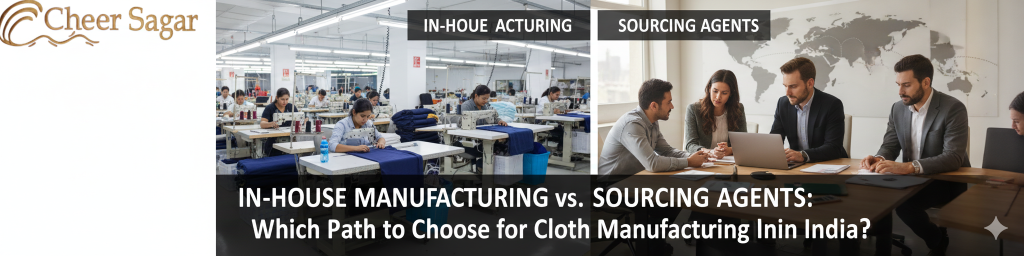
The journey of bringing a fashion brand to life is filled with critical decisions, but perhaps none is more pivotal than choosing how your garments will actually be made. For entrepreneurs entering the vibrant landscape of cloth manufacturing in India, the dilemma often boils down to two distinct paths: working directly with an in-house manufacturing facility or hiring a sourcing agent to manage the process.
While both models have their merits, understanding the technical and operational differences is key to long-term success, especially when quality and transparency are your top priorities.
Understanding the Direct Route: In-House Manufacturing
In-house manufacturing refers to a setup where the factory owns the entire production cycle—from fabric sourcing and pattern making to stitching and final quality control. When you partner with a direct manufacturer, you are cutting out the “middleman.”
1. Unmatched Quality Control In the world of apparel, especially if you are a Kids wear manufacturer, quality is non-negotiable. Children’s clothing requires extra attention to safety standards, soft fabric finishes, and durable stitching. By working directly with a factory, you have a direct line to the production floor. You can implement specific quality benchmarks and ensure they are followed at every station.
2. Cost Efficiency at Scale Bypassing a sourcing agent means you aren’t paying a commission—which usually ranges from 5% to 15% of the total order value. For brands looking for consistent, high-volume production, these savings can be reinvested into better fabric or marketing.
3. Faster Communication and Sampling When you speak directly to the makers, nothing gets lost in translation. Technical adjustments to a sample can be discussed and executed in real-time, significantly reducing the “pre-production” lead time.
The Role of Sourcing Agents: The Middleman Perspective
Sourcing agents act as facilitators. They don’t own the machines; instead, they have a network of various factories.
-
The Advantage: They are useful for brands that don’t have the time to vet factories themselves or for those who want to source very small quantities across dozens of different product categories (e.g., shoes, bags, and shirts all at once).
-
The Downside: You often lack transparency regarding which factory is actually making your clothes. If a problem arises, you are reliant on the agent to fix it, which can lead to delays and “finger-pointing” between the agent and the sub-contracted factory.
Why Global Brands Prefer Integrated Garment Exporters
For international buyers, the goal is often to find reliable garment exporters who can handle the complexities of shipping, customs, and global compliance. An integrated manufacturer that also functions as an exporter provides a “one-roof” solution. This eliminates the fragmentation that occurs when using multiple agents, ensuring that the brand vision remains consistent from the first sketch to the final shipment.
Choosing the Right Partner for Your Brand
If you are a startup or an established label looking for reliability, the “Direct-to-Manufacturer” model is almost always superior for maintaining brand integrity. It allows you to build a relationship with the people actually sewing your labels, fostering a partnership built on mutual growth rather than just a transaction.
Conclusion
Navigating cloth manufacturing in India doesn’t have to be a maze of middlemen and hidden costs. By choosing a partner that offers end-to-end transparency, you secure the future of your brand’s quality. Cheer Sagar stands as a testament to this philosophy, combining decades of expertise as a leading garment manufacturer and garment exporter with a specialized focus on high-quality production, including being a trusted Kids wear manufacturer. When you work with an integrated setup, you aren’t just buying a service; you are investing in a seamless supply chain that values your brand’s excellence as much as you do.